

Deaf Dogs
Deaf dogs are quite often written off as too difficult to train, unable to recall or be let off the lead and generally unable to live a 'normal' life. But a deaf dog only has one of the five senses missing and can accommodate for this loss much better than you might imagine. With their heightened sense of smell and eager eyes, a dog without hearing can understand, interact and learn just as well as their hearing companions.
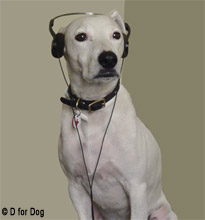
With a little time and imagination from the owner, deaf dog training is as easy and rewarding as any dog training, if not more so because you have their full focus and they will be thrilled to finally have communication and fun instruction. They can learn all the behaviours that a hearing dog can, including recall.
Deaf Dog Hand Signals
The key to a 'normal' relationship with your deaf dog is to use hand signals in place of the spoken word. Some people learn commands from UK or USA sign language standards. Alternatively, and probably even better, is to make up your own hand signs to suit you and your dog.
Have some fun and be inventive but bear in mind that all signs should be clear, easily distinguishable from other signs and preferably performed away from your body so that your sign is clearly visible to your dog. For this reason, by all means look up some official signs but do adapt them to your own needs, or change them completely into something that you can easily use and remember.
We made up many signs for our deaf dog, Berkeley. Only a few of them are large and away from the body such as the recall sign. Most are more discrete as Berkeley is very observant and also rather frightened of large sweeping hand movements. See how you get on and don't be afraid to adapt your signs to your own dog's needs.
For some examples please see Deaf Dog Hand Signals.
Using Hand Signals with a Deaf Dog
Whatever hand signals you choose to use, the vitally important thing is to be consistent. Make a note of the signs you intend to use and maybe draw them or photograph them. Put them on the fridge door or somewhere easy to view and stick to those signs.
Start to use your signs exactly as you would normally speak to a hearing dog. Start with some everyday pleasant events such as a sign for "dinner time" and a sign for "walkies". These are two activities that most dogs love. So, for example, get your dog's attention with a gentle tap near the shoulder blades and sign for "dinner" and then put the food bowl down or sign for "walkies" and immediately get the dog lead off its hook. You will be amazed at how quickly your deaf dog will come to associate the hand signal with the event that follows.
Keep using your chosen sign and watch your dog's reaction. If they respond with excitement expecting walkies or dinner then you have successfully communicated to your deaf dog. Congratulations. It is a great feeling isn't it.
Once you have successfully taught your dog a couple of easy signs you will be surprised how easily and quickly the rest of the signs will follow. Your deaf dog soon learns that your hands and movements are telling them interesting things. Once that happens you are both well away.
Speak as you Sign
It is always a good idea, when signing, to also speak to your dog as you do each hand signal. If you are signing something happy such as "walkies", it helps if you are smiling as you sign. As you sign "walkies" also say "walkies" and this will show in your face. Dogs are experts at reading body language, including facial expressions. The sign will be learnt quicker and have more meaning to your dog. Speaking as you sign will help you to convey your meaning.
Deaf Dog Training with Hand Signals
Now you are in the swing of using your hand signals consistently and for everyday activities, you can begin some basic training. Remember, we are training a dog, it just happens to be a deaf dog. The basic rule is to train the same way you would train a dog that can hear but add hand signals to your verbal commands. It is important to remember this. All the usual rules of good basic dog training still apply.
Train your dog using whatever motivates them, be it a food treat or a favourite toy. Keep training sessions short (5-10 mins per session) and always end training sessions on a positive note such as an easy trick that you know your dog can perform. Never shout or loose your temper and never train if either of you are tired or getting bored. Always use positive training methods as you will get much better results and your pooch will thank you for it. You want to build a relationship with your dog, working together and having fun while learning.
Training a deaf dog is not really that different to training a hearing dog. At most it will involve a little more time and patience, but it is possible and deafness is never an excuse for a poorly behaved, under trained pooch.
Thinking of Adopting a Deaf Dog?
When we adopted our deaf dog Berkeley I can't tell you what a fantastic decision it was. My bond with him has been like no other. I find him incredibly responsive, a joy to train and so much fun to live with.
If they are the dog for you, don't let a lack of hearing put you off.
Further Info - Books
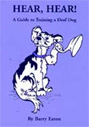 | Hear, Hear! by Barry Eaton A guide to training a deaf dog |
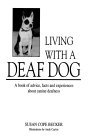 | Living with a Deaf Dog by Susan Cope Becker A book of advice, facts and experiences about canine deafness |
I started out with both these booklets and can't recommend them highly enough.
Further Info - Websites
The Deaf Dog Education Action FundDDEAF - Fantastic site covering many deaf dog issues.
Deaf Dog Training by Barry Eaton www.deaf-dogs-help.co.uk
Whether you have knowingly given a home to a deaf dog or puppy, or discovered later that your much loved pet is deaf, you will probably need help training it.
The Deaf Dog Network
The Deaf Dog Network has helped to save a number of puppies born deaf from being killed, helped save deaf dogs on death row, promoted deaf dogs in rescue and supported owners of deaf dogs who did not know where to turn.
Deaf Dogs Rock
Loving and caring for deaf dogs. Lots of information and training tips.
By Jenny Prevel
© D for Dog www.dfordog.co.uk
This article belongs strictly to D for Dog and we do not authorise the copying of all or any part of it.
It strikes me that the following sentence: "The key to a 'normal' relationship with your deaf dog is to substitute the spoken word for some hand signals." should read "The key... is to substitute hand signals for the spoken word." Just thought I'd point it out... Hope you don't mind. Cheers, Philip :)
Thank you but I am not sure. Yours is the wrong way round, isn't it? You substitute words for signs not signs for words. Hum... I think I will just reword it :-)
The thing you substitute is the thing you use. So I agree with Philip, but maybe it would just be easier to write that we primarily rely on signs. I have found American Sign Language (ASL) easier than British Sign Language (BSL) with my puppy and his hearing sister. That’s because the American system uses 1 hand, while BSL often needs both. But I do agree that using spoken word alongside sign is useful, as it brings facial expression.
Our mongrel puppy was about 6 months when we realised she was deaf (vet confirmed). A few lessons with a dog trainer helped with basic training as I had never had a dog before. The hand signals we use are almost like emoji signs: thumbs up = good girl! Flat hand held up with finger spread = stop etc. I can walk or run in the park with her off lead. Her distance recall is to pick up a stick so as to throw it and she runs towards you. She stops and sniffs and does her own thing and always runs to catch up. I think because she doesn't hear she isn't reactive at all (eg. she doesn't respond to other dogs barking or the door bell ringing). I find it hard to interact with other dogs with out hand signals and body language.