

How to Remove a Dog Tick
When removing ticks it is best to wear latex or rubber gloves to prevent any of the tick's blood from getting onto your skin because Lyme disease and other diseases could be spread this way.
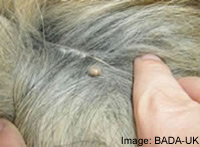
Ticks should always be removed as soon as possible from your dog. Prompt, safe, complete removal of ticks helps prevent illness.
Using Tweezers
If you do not have a specific tick removing tool then tweezers may suffice but we do not recommend this method over the use of a specific tick removing device.
If you don't have a tick removal tool, grasp the tick firmly with tweezers where the tick's mouth meets the dog's skin. Slowly and steadily pull the tick, trying to get the whole tick at once. Don't twist the tick or jerk as you may break the tick's body and risk leaving it's head behind. After removing the tick, clean the area with an antibiotic, alcohol or another disinfectant. The tick should then be killed by soaking it in a jar of alcohol.
If part of the tick remains buried, try to get the rest out by using a needle boiled in water for five minutes, the way you would remove a wood splinter. Afterwards, cleanse and disinfect the area as before.
How NOT To Remove a Tick
Do not try to remove a tick by burning it off as this does not work, may hurt your dog and may cause the tick to regurgitate its potentially infectious fluids back into the skin. Similarly, do not apply surgical spirit, Vaseline, nail polish or in fact ANY substance or chemical to the tick. The application of any substance or any source of heat or cold can stress the tick and cause it to regurgitate the contents of its stomach into your dog, which may contain infective organisms. Surgical spirit, alcohol or general antiseptic should be applied to the bite site only after the tick has been removed.
Using a Tick Removal Tool
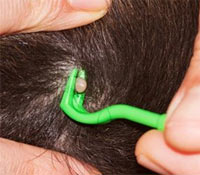
We recommend the Tick Twister tick remover or similar tool. The Tick Twister is the safest way to remove ticks without leaving parts of the tick in the skin and is also the tool recommended by BADA-UK (Borreliosis and Associated Diseases Awareness UK). It does not use chemicals and it takes the tick away quickly, painlessly and safely. It does not squeeze the tick, thus reducing the risk of infection. The tool is designed by a Veterinarian.
Prevention
Ask your vet about effective tick control (spray, powder) or anti-tick medication for dogs, especially if you often walk your dog in woodland areas or areas where there are high grasses. Dogs should be checked thoroughly for ticks after every such walk. Pay close attention to ears, face, eyes, legs, and belly. Ticks favour warm, safe nooks and crannies.
By Jenny Prevel
© D for Dog www.dfordog.co.uk
This article belongs strictly to D for Dog and we do not authorise the copying of all or any part of it.
just got a new rescue puppy 8 mths old who loves her country walks. your video was really very good & I am fully prepared now. Thanks very much. Horrid things!!!
Just done this and I'm pretty sure it just twisted the tics head off....only the body came off. This is a terrible tool, think about it....the tic is tightly clamped on twisting it is not going to release that grip, its just going to rip its head away! I think I'll stick to pulling it out with a hair grip.....
Hi Lisa, what makes you think you left the tick's head in please? Can you see any body parts on your dog's skin? What does the tick look like? Is he in one piece? It is a great tool and easily removes ticks. With a few gentle rotations, being sure not to pull, I promise you, the tick does simply release it's grip. I have used one a number of times and it is BADA approved. The tool does not clamp the ticks body or rip its head off. Please explain more about what happened, how you used the tool and what you are seeing.
Hi I would highly recommend the tick tool. I have just recently been diagnosed with lymes disease. Not pleasant. I got a tick from my horse from a high deer populated area. I squeezed it to pull it out as I did not have the tick tool to pull it out. What I did was stress the tick out and it put back in the infected blood to the bite wound. I now carry the tool with me when out with my pets.
I don't think you should be recommending tick removal by pulling out with tweezers, I see you do recommend a proper Tick Twister further down the page, but someone on one of my groups has tried to remove a tick by pulling straight out and of course the head has now come off embedded in the dog and they will have to take him to the vet to have it removed
I totally agree Lucy. "If you do not have a specific tick removing tool then tweezers may suffice but we do not recommend this method over the use of a specific tick removing device."
Respectfully suggest that the simplest way to remove a tick is one I've seen only one result for when googling. Simply gently agitate the tick with a circular motion for up to a couple of minutes and it will release itself and drop off still alive.
Hi Peter, the problem with agitating a tick for a few minutes is that you risk distressing it and that is when it can regurgitate and transfer any nasty diseases it might be carrying to your dog. With Tick Twister the tick is not aware of anything happening and it only takes a few seconds. It is the safest tick removal method.
I have just found a tick on my dog and have a tick remover because it is only a new attachment when I went to use the remover it just slid over the tick. It has embedded into the side of his manly bits where it is quite soft do you think a trip to vets is necessary or whether just to try again later?
Hi Sara, if you have a Tick Twister it comes with 2 tools in the pack. If you used the larger tool and that is why it slid over the tick, try the smaller of the two tools.
Since I purchased the tick removal tool several years ago my border collies have been fortunate not to have had ticks on their coat. before that I always used to spray ticks with frontline spray.which works.
As mentioned above, it is not recommended to spray, apply or otherwise ANY substance to the tick in order to remove it.
I have read some of the comments and am amused, concerned about refferences to tics having heads. Ticks do not have heads. They have mouthes and legs but no head
Very sceptical about using this product as the whole’ twisting’ method seems a bit controversial. However it was the last remover in the pet shop and my 1 year old was covered in ticks. I removed 12 live intact ticks with this device.... have tried tweezers in the past with bad results. Make sure u clear the animals hair and slide the ‘fork’ right in & up to the ticks body. May take more than two or three turns. Can’t recommend this product more highly!!