

How to Empty Your Dog's Anal Glands
In this easy to follow blog and video, I will show you how to express your dog's anal glands at home, safely and easily, using the external method gently without causing your dog pain or injury. If you are wondering how to drain a dogs anal glands, keep reading.
No need for a trip to the vet. We show you how to empty your dog's anal sacs at home. I was taught this method by a vet, so it is a veterinary approved method for a full anal gland problem. It is what is known as the external method, as opposed to the internal method, which can be slightly trickier and more invasive.
We answer questions such as:
- Why does my dog smell of fish?
- Why does my dog scoot on the floor?
- What are anal glands?
- Where are the anal sacs located?
- Do all dogs need their anal glands expressed?
- How to express a dog's anal glands at home
With the agreement of your veterinarian, you can definitely empty your dog's scent glands yourself, at home. We show you where to locate them, the position of the sac openings on the dogs anus and how to gently milk (not squeeze) the sacs so that they drain easily and without causing your dog pain. We also show what you will see, how you will know when the glands are empty and how often expression should be done.
Video showing how to empty your dog's anal glands
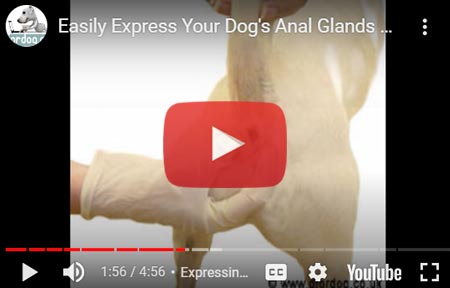
What are anal glands?
A dog's anal glands are situated either side of their bottom (anal opening). The fluid inside has a potent smell that is unique to your dog so it is great for marking territory and giving lots of personal information to other dogs. Most dogs never have an issue and will never need their glands emptying but if your dog scoots their bum along the floor or smells a bit fishy, they may have an issue with full or impacted anal glands.
Do all dogs need their anal glands expressed?
No, most dogs do not need to have their scent glands emptied manually. For most dogs the sacs will function normally. Dogs naturally empty a small amount of anal gland material each time they have a bowel movement. But sometimes they do not empty naturally or do not empty enough and this can lead to the glands filling up and becoming uncomfortable, leaking at inconvenient times or even becoming impacted or the dog suffering with infected anal glands.
What dog breeds need their glands expressed?
It doesn't seem to be a specific breed issue but smaller dogs like the Cocker Spaniel, Chihuahuas, Beagles, Miniature Poodles etc... do seem to have more of a tendency towards anal sac disease and issues like full or an impacted anal gland.
What causes dog anal glands to fill?
A dog's diet may lead to anal sacs that do not empty on their own. During a bowel movement, a large firm stool will usually trigger the release naturally. A small or soft stool may not activate the anal sacs and if this continues the sacs will continue to fill up. Sometimes the dog's poop may be the perfect firmness but the dog still suffers with full or anal gland impaction. You can also cause issues if you empty them for a dog who didn't need it doing. If your dog doesn't have an issue in this area, leave well alone.
How do you know if your dog's glands need emptying?
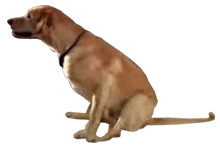
A dog with full or anal gland problems may scoot their bottom along the floor, scratch, bite or lick at their bottom or tail, have a fishy smell at the back end, seem in pain or depressed, object to anyone going near their back end.
- Drag their bottom along the floor (scoot)
- Try to scratch, lick or bite at their bottom (or even other areas of their body like their feet)
- Smell fishy from their bottom (or breath, if they have been licking their behind)
- Wag their tail less
- Seem depressed
- Object to their tail being lifted or handled
Big indications of anal gland issues are scooting and the fishy smell. The fishy smell occurs if the anal glands have gotten too full and they start leaking at times other than when the dog is toileting. Anal gland fluid has a very potent rotten fish smell. Full anal glands can leak when the dog is at rest, sleeping or is picked up.
There is a common misconception that a dog will drag their bottom along the floor when they have worms. In reality, it is most likely to be because of full anal sacs. Your dog is trying to release the fluid and relieve the discomfort. The strong fishy smell is coming from anal glands that are full but leaking some fluid. You may smell it on your soft furnishings or actually coming from your dogs bottom.
If you notice these things it could be that your dog has an anal sac issue and/or your dog’s anal glands are not emptying correctly on their own. If it just happens occasionally then that is quite normal and no cause for concern. Your dog only needs help if the problem becomes frequent.
Who should empty them?
Always get the advice of a veterinarian first, to check that the problem is anal sacs and that there is no infection.
If it is an infrequent problem or you do not fancy trying to empty them yourself, your vet or your local dog groomer can help. It is a relatively simple 5 minute procedure. Alternatively, you can do anal sac expression yourself, with a little patience and know-how. But for the first time it is best to visit your vet so they can check your dog first. Once infections or other issues are ruled out, your veterinarian will usually agree that in future you, the dog owner, can empty them at home. A good vet will be happy to give you some instructions on how to do this.
Can I empty my dog's anal sacs at home?
Yes, with a little practice, patience and gentleness. The key is to relax (you and the dog, lol) and to take it slowly. Do not rush or panic or go at it with too much vigour. Be gentle and patient.
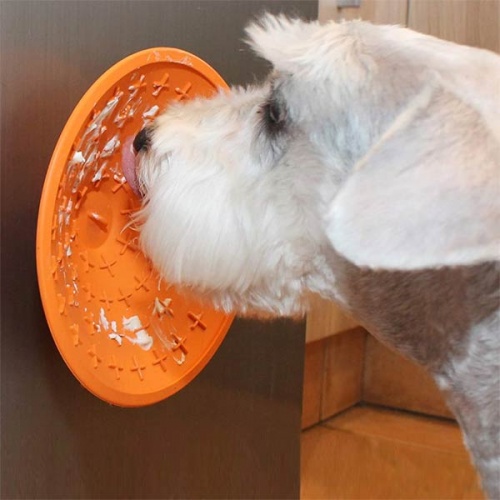
It isn't really a one person job though, unless your dog is likely to stand still and let you do this. It is easier if you have another person gently holding and reassuring the dog while the other person works at the action end. However, if another person isn't handy to help, buy a lick mat. These are the perfect way to keep your dog busy and engaged and less likely to walk away. They are great for jobs like this and also to use at bath time, during grooming, for nail cutting and more. Woof! Our favourite is the LickiMat Splash Dog Lick Pad. These are similar to the lick mats you may have seen before but LickiMat Splash is an innovative curved shape to keep the licking contained inside the lick pad, so that means less mess and less licking of your floors or walls, lol.
Can a dog express their own glands?
Absolutely. In fact that is how the anal glands should work. They should empty a little at a time when the dog passes a stool. So dog's should naturally empty their own anal glands, if everything is working as it should. Human intervention is only needed when the anal glands don't empty naturally.
Where are a dog's anal sacs?
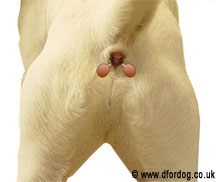
To help you successfully express the anal glands you need to be aware of where they are and where they drain from. The image shows where the anal glands are situated and where the openings are. They are at about 5 o'clock and 7 o'clock, as shown. The all important openings are above each sac, pointing inwards, towards the dog's anus. This is where the fluid will drain from.
What will I need?
You will need a latex glove (a household rubber glove is alright to use but they are less sensitive for you to be able to feel through), some paper towel and preferably another person to help.
Does it hurt a dog to express glands?
If you do it gently and correctly it should not hurt but it may be slightly uncomfortable for your dog. They may wonder what you are doing back there but the relief afterwards will make up for any discomfort.
How to express a dog's anal glands?
We are going to use the external method. Stand your dog on a safe, easy to clean surface. Have the other person gently hold your dog still in a standing position so your dog doesn’t walk off or sit down. But try not to frighten or panic your dog. Ensure they are relaxed. This makes the dog less likely to squirm or clench their bottom.
You must be as level with the dog’s bottom as you can and try to be a comfortable position yourself. Do not sit or crouch in a way that is going to be uncomfortable for you after a few minutes.
Emptying a dog’s anal glands is easy once you get used to it but, especially to begin with, it can take time and patience. I prefer the external method for emptying the anal sacs. It is easier to do and less intrusive for your dog. You can also do both sacs at the same time. Result!
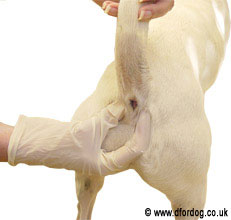
Here's how to do it...
Gently hold your dog’s tail up and out of the way. With your gloved hand, place two fingers (thumb and forefinger) either side of and slightly below your dog’s bottom (see second image).
Full anal glands will feel like two large peas. Sometimes only one sac will be full rather than both. This can indicate that the glands were generally emptying OK on their own but for some reason one has become impacted and maybe also infected. A course of antibiotics and some pain relief may be required. Seek advice from your vet.
How do I squeeze a dog's anal glands?
Never squeeze the anal glands. This is a mistake so many people make. A gentle motion is all that is needed. Once you can feel the anal glands, gently milk them in a slightly inwards and upwards motion. Review the first image again so you can see exactly where the anal glands open. That is the direction to milk the sacs. Do not squeeze or apply too much pressure. The key here is to gently milk them.
When expressing dog anal glands, what will I see?
As you are milking, watch your dog’s bottom. If nothing comes out, adjust your fingers slightly and adjust the angle of the ‘milking’ and try again. Be patient and keep trying a few times until you see a drip of fluid escape. You can now keep your fingers in that position and continue to milk the glands in and up until they are emptied. Sometimes it can squirt out and take you by surprise. Try to take it in your stride. Don't scare your dog.
The anal gland material usually smells strongly of fish and can be anything from a clear or white smooth consistency to more of a brown grainy substance. Don't be worried by this. The colour and consistency of the anal fluid can vary from dog to dog and also from expression to expression. Unhealthy looking fluid would be pussy or green. Seek the advice of your veterinarian if this is the case.
How do I know when the anal glands are empty?
You will know when you are finished because the sacs will feel deflated and the fluid will stop coming out. Gently wipe your dog’s bottom to remove any dribbled fluids and give them a nice treat. Good boy (or girl)!
However, if after a few tries you are unsuccessful, stop and try again another day. Repeated milking of the glands can cause pain and bruising. This can make the problem even worse. If you still do not have success please ask your vet for advice.
The internal method
Another method of anal sac expression, often used by vets, is to insert one lubricated gloved finger gently into your dog’s bottom to feel the sac and empty them one at a time. This is the internal method. I find it more intrusive for the dog and trickier to do so I always use the external method.
How often should I express my dog's anal glands?
Sometimes the glands only need to be drained once in their lifetime and they will have no further issues. However, some dogs have ongoing issues with their anal sacs not emptying naturally. If a few weeks later you see some of the signs mentioned above (scooting, fishy smells etc..) then the glands have probably filled up again.
If your dog has an ongoing issue, it is best to schedule a reminder to check your dog’s anal glands regularly and empty them whenever they feel full. How often this needs doing will vary from dog to dog but scheduling a remind for once a month is a good starting point and go from there.
I can't say this enough - please only empty your dog's anal glands if it is necessary. Anal gland expression is not something that should be done routinely just because someone can. I have heard of some groomers for example doing anal gland draining as part of the ear cleaning and nail cutting routine. Messing about with a dog's anal glands for no real reason can actually cause problems. Let your dog's own body do it's job where possible.
Removal of anal glands
This operation can be performed in certain circumstances but due to complications it is not recommended as a general solution. Faecal incontinence is a recognised side effect of anal gland surgery. Be really sure that the issue can't be managed another way before considering this option. For more information and case studies, see the medical library Anal Sac Removal, Elective by DVSC.
Other solutions
As mentioned above, check your dog’s stools for size and firmness and adjust their diet to a high residue (cereal based) diet if the stools are too small or soft. You could try adding bran to firm up the stools and bulk them out. A couple of teaspoons a day for a medium sized dog should suffice. Reduce your dog’s weight if he is overweight. These solutions aim to aid natural anal gland emptying.
Want more?
Why not check out some of our other popular dog blog and/or subscribe to our newsletter. It is packed full of useful information, shiny new things and special offers. We make it easy for you to keep up to date. Woof!
Or if you fancy a bit of doggie shopping, check out our online dog product shop, from great gift ideas to toys and accessories. We are one of the UK's leading pet supply stores so you are always in great hands at D for Dog.
If you are looking for dog care and grooming products, check out our range here Dog Care & Grooming which includes cooling coats and mats, pet towels and drying coats, sun vests, paw balms and everything you need for pooch care and pampering.
By Jenny Prevel
© D for Dog www.dfordog.co.uk
This article belongs strictly to D for Dog and we do not authorise the copying of all or any part of it.
Last update: 7th May 2019
very well explained ,great advice ,thankyou.
Thank you this was very helpful
Thank you so much
This was very helpful and so well explained thank you
Thanks for the help
I learn more from my UK dog sites than my U.S. Thanx! My own vet can't do this!
I KNOW! My vet won't teach me, though they do know how to do it. Seriously, if I don't know how to do it and can't afford a vet visit, my dog should not have to suffer! Thank you, Dfordog for posting this!
Now I know why my rizla moans when we touch his bum at times. Over 7 years I've smelt the fishy stink ONCE only so it's good to know wall is ok. This video is brill! At least we can have ago ourselves. Thankyou
Excellent job !!! Very helpful
Very informative. Love the accent in the Viideo, too. Now to try on my 3 lb. chihuahua, Chico!
Thanks for the excellent video. My Cali has this problem often. My hope is to have success at getting her some relief. 😋
Yes, this was very helpful.
Thank you
Very clear to follow, will be able to try and clear 2 of my dogs taking your advice, thanks.
OH MY GOSH! Where has this article been for the last year!? We knew something was wrong and resorted to using a waterproof blanket on our bed for our dog to sleep on. We would wake up smelling that foul smell and had no idea what was causing it! We will definitely visit with our vet. Thank you so much!!
Thank you
thank u very much
Hi my dog had his analysis glands done for the 1st time 3 days ago,at my groomers,since then he has not been himself.does not want to go out.sleepy.and smells so bad of fish at back end.have kept wipeing with wet cloth but still smells.is only 14 months old a shitzo.
If the anal glands are still leaking, it sounds as if they have not been fully emptied. Did the groomer have good reason to be doing them? I would take your dog to the vets to see what is happening and have them emptied professionally.
I am a dog groomer.... if ur dog groomer did ur dog analysis glands then it's should be leaking in 3 days.... it may even that the groomer tried to empty the glads and couldn't get anything out. Or only got a tiny bit out... but if they did a proper job then u shouldnot be having leaking oyou 3 days on..... try and either empty them ur self stand ur pup in the bath and knee on the floor or pop her to the vet and explain what's going on.... ur pup may have a blockage... that ur groomer has half unblocked..or ur groomer may have tried so hard that she has bruised ur dogs glads.. but do get it looked at. Cos it's not nice for u or ur dog
Go see your vet asap
thank you ,very informative
Great explanation. I have a shih tzu that has always needed this done. After several trips to the vet I decided to try on my own. Poor Sam Sam he is so good and patient. Occasionally Sam still needed a trip to the vet due to an impacted gland. After expressing it you could see a little plug (yuck) come out. The vet then recommended that prior to expressing the gland I massage his glands with a warm towel to help dissolve slight obstruction. I am happy to say that this worked great! Happy dog.
What a great idea. Thank you very much. I am sure others will find that helpful too :-)
Thank you so much for this video. My poor little Shugie has a terrible problem. My vet said he had never seen glands fill as fast as hers. I have contimplated having the surgery, but now that I know the side effects, we won't be doing that. I will definitely be trying the external method. Again, thank you for this video
You are welcome. We also said no to the op for Berkeley. Once you get used to doing them, it is a 2 minute job.
My little adopted poodle had constant anal horrible smelling leakage.After several months of vet trips,I changed Vet who put her on 21 days of tetracycline oral treatment.Magic Never had another episode and never needed draining again.
OMG, I seen liquid coming from my Niko's behind, but since he had it since puppy I didn't think too much about it, and every now and then I would smell fishy smell, and I thought he needed to go to the groomer!! Well now I know he needs to see his vet, and I will get him there as soon as possible!! Can't wait for him to feel better, when he is down, I'm down too, he really is my best friend!! Thanks for such a great video!!
Thank you so much for the video, and explaining about emptying the annal gland, very useful, and clear.
Thank you again.
Thank you ,tried a few times but no luck yet ,will keep trying
Excellent instructions, I feel like I can do this now. You have no idea how bad an alpha-male bullmastiffs' full anal glands reak. Or do you
Atrain, hope you don't mind me asking, but how did your Mastiff's gland draining go? I have an 18 month old Bull Mastiff and this is the first time that he has needed his glands emptied. As you'll know, a larg 11stone dog cannot quite get to himself to scratch etc so he's resorted to wiping his rear end on my furniture :-(
EVERY PET OWNER SHOULD SEE THIS SITE,VERY INFORMATIONAL,THANK YOU FOR ADVICE!
Thanks for the great advice, as this is the second time our dog has had this done at the vet. Any advice on how to prevent it from recurring?
You are welcome. As mentioned above, the dog’s diet may be to blame for anal sacs that do not empty on their own. A large firm stool will usually trigger the anal glands into emptying naturally. So if your dog has soft stools you may want to look at why. The reasons are various and many, from a poor quality food, intolerance i.e. a food that doesn't suit their digestion or other reasons which may be medical.
Fantastic, great video and very clear instructions,
Now I have a happy dog.
Does thus condition occur in cats too? If so, is the procedure the same? Your recommendations and comments, please.
I'm sorry, I have no idea about cats. You will have to ask your vet.
Thank you for the fantastic article on how to fix this gland issue. I've just done it for my dog Penny. Really easy to do works exactly like you discribe and I'm positive Penny is over the moon too. I'll pass on your website to all my friends with dogs, 100%
My dog, Sam, has this problem and I take her to the vet every two to three months to have her glands expressed at the cost of $30. If I can do this successfully, it will save me some money, and I will not have to wait for an appointment. Thank you for this very helpful video.
Brilliant explanation. This is the first time I've had to do this with my dog after having her for 8years. Took a few attempts to get the right position for my fingers but once adjusted the sacs emptied relatively quickly. Definitely not the most pleasant experience I've had with my dog I must add. Your instructions state clear guidance. Thank you x
Great video I will try this on my beagle as she has a problem with her anal glands on a regular basis. My vet suggested removal of the Glen's or to have them flashed. I certainly don't want to have them removed but could someone please tell me have they heard of flashing off the anal glands. I would be very grateful if someone could help me please. Thanks
Hi Jess, I think you might mean having the anal glands flushed. This is exactly what it sounds like and is sometimes done if the anal sacs are blocked and/or infected. I am surprised to hear that your vet has suggested removal. All other avenues should be tried first. Removal is a very drastic measure and can cause more problems than it solves.
Thank you for your quick reply. Yes I did mean flushing. My first port of call will be to add some fibre into her food and also try and squeeze her anal glands as shown in your video. I also was surprised that the vet said possibly removal of the anal glands as I think it can make then incontinent. Your article and your video was very informative thank you.
You are very welcome. Don't forget... milk not squeeze :-)
Great site. I have been expressing my dogs glands for about 2 years now on a monthly basis. i did change her diet and she did lose weight but the anal glands remained the same. Anyway, they always feel empty after I do it and nothing else cones out but she still scoots. Any idea what I am doing wrong?
Hi Rebecca, so it sounds like something else, other than full anal sacs, is making her scoot. If she scoots for those few days after you have emptied her glands, it could be that you are doing them a bit too vigorously and they are a bit sore or bruised afterwards. If she is scooting throughout the month, there may be some other issue or irritation and a visit to the vet may be in order.
I watched your video for the external procedure for emptying my dogs anal glands, and tried it. I was very successful and I was amazed how easy it was to do. Thank you very much for all your help!
That is so great to hear Gary. You are very welcome.
I just wanted you to know that your site was the most detailed and most informative on this (lovely subject) that I was lucky to find. And I watched a whole lot that didn't go into the detail that you did. The video along with the pictures covered it all. Thank you.
That's good to hear. You are very welcome. I hope it helped.
Thanks for that.
My dog was having the same problem and the vet told us to give our dog a tablespoon of blueberry yogurt or canned pumpkin every day. Believe it or not, it worked. Helped with stools and no more smell.
Sounds good. Thanks for the tip :-)
My dog is a rat terrier he's 2 years old and he's a bit skittish, well today I tried to get my dad to hold him well he had freaked out and this milky white stuff squirted out from his bottom and it smelled really bad. After that he started to lick his bottom.
What a great video.I took my small and very itchy pom-shirt to the vets yesterday and she emptied his glands internally.it was quite disgusting. But he is a lot better now. I have actually phoned the vet and asked if it was ok to do it myself but not internally but in the way you showed. And she said it was ok. So I will try it in a few weeks and let you know how I get on.Thankyou
Only just found out today that all his symptoms are exactly the same can it kill him
No, don't worry. Take him to the vet to get it confirmed and check for other issues etc... and then discuss the emptying of the anal glands, let the vet check for any signs of infection and go from there.
Wow thank you so much! I have my pit Jax and he was feeling miserable with a fowl fish smell- just expressed his glands and will change his diet! Your video was awesome help! Thank you
Can blocked anal glands make a dog feel unwell?
I wouldn't think unwell as in the sense of their general health but it would certainly be irritating at best and even painful.
Thanks so much for the video. Can't wait to try it. I have a 2 yr old English bulldog and have been noticing this smell for quite some time and thought it was just she needed to go to the groomer. She has had them expressed when she gets a bath but days later still smells like fish. I will try this monthly when I bathe her. Thanks so much for the info.
Thank you so much for this video! We watched it after our 4 mo old pup started having a stinky butt, and just milked his glands pretty easily thanks to this video! He's always scooted his butt, my Fiance thought it was when he had to poop, but could this have been the cause?
You are welcome and yes, scooting is often a sign that the anal glands are full.
I have a little dog that has his anal glands drained by the groomer. I wish i had seen the video. I did it myself once and some liquid came out but I'm concerned that i did it the correct way.
Hi, thank you for the video. .. was extremely helpful. My dog has constant anal sac problems. I have learnt to notice the signs, so I get her to the vet before they get infected. However this is an expensive solution!
My dog suffers from allergies and is on special allergy management food this seems to be working! The vet suggested a pro biotic to firm up stools? I have also heard that a teaspoon of bran may help? She is a jack russelll x and is around 10kg. Any suggestions very gratefully received.
Our situation was really similar. Every month they would fill up and not empty of their own accord. We also tired a probiotic and while I think it did help his sensitive stomach I noticed no improvement in his stools. That is why I ended up learning how to do the emptying at home. If you decide to try that, I hope you find the video helpful.
Hiya, I have a 13 week old jack and last Wednesday the vet drained them but said it was a lot for her age. She has started the same behaviour again today. The problem I have she has a very sensitive stomach so last week had normal stool but was being sick so put on diet for her sensitive stomach this week her stoold is softer but doesn't seem to make any different on her stool as despite hard or soft she is still having the same problem. We r going to try and drain them ourselves tomorrow as can't keep taking her to the vetshop weekly.
I agree with E Bennett. I had an almost 16 yr old Shitz Tzu. His anal glands had to be expressed ever so often. Sometimes, he could do it on his own. And sometimes he needed help. I found that in the beginning, as a pup, his food was a lot of the reason. He needed GRAIN-FREE. Secondly, was ALLERGIES. The poor little thing was allergic to bout everything, even grass I think. And thirdly, was loose stools. All the other things would give him very loose stools, & make that anal fluid build up in those sacs. U cant let em go too long like that, they will get impacted & cause infection. The fluid will turn real thick & yucky. It dont want to come out at that point. Vet time. ❤ Good luck
Hi,
My boy’s glands get filled up very quickly. What did you do to your dog to resolve the issue?
My dog won't let me anywhere near his back end,he would bite my hand off,if not more. He turns really viscous and would attack? Any ideas?
Start very slowly Teri. To begin with simply stand your dog in the position you will want him to stand in, with a helper at the front, exactly how you will be doing it for real one day. Get your glove on and crouch down into the position you will need to be in. Hopefully your dog is fine at that stage so treat and praise him and leave it at that. Do that a few times over the next few days and then start to progress, so for example the next thing to add might be to touch his bottom. If he is fine with that, praise and treat him and do that again over the course of a few days and so on. If you ever do something that makes him anxious or snappy, go back a stage to something he was comfortable with and start that part again but slower this time.
I had my 7 year old Wheaten Terrier/Poodle's anal gland (only one side was full) expressed 4 days ago at the vet and she is still leaking? Is this normal? We have never encountered a problem with her glands before...
It is possible they were not fully emptied, or I can't see how they would still leak. I would give your vet a call.
nicely done
Hello, are 6 month old male jack Russell puppy eat something that he should not of outside and has a upset stomach, two days ago, we have put him on some dryed mixer with fresh chicken, and it seems to be helping, his stool is still very soft and upset but not as bad as it was but just now as he was squatting some clear fluid come out, it was not poo and did not smell , is this his anal gland, or is he to young to have this problem,
Hi Zak, it doesn't sound like anal gland fluid. It sounds more like a mucus coming from his bottom, related to his upset stomach/bowels.
Ok, thankyou🐶
Thank you so much my little poddle x westie has had this trouble on and off for a while and that smell I wash him and its back . thank you will be taking him to the vets is there any amount of time between when he needs it done?
Hi Christine, it really can vary. There is no fixed schedule. Once a month used to work for our terrier but maybe feel them every few weeks to see how quickly or slowly they are filling up.
My 6 month old lurcher Desmond has started growling whenever our 10 week old pup goes near his bum its usually when dennis is climbing over him hes been doing it since we got Dennis. His bum dosent smell of fish and he dosent scoot or wipe his bum anywhere and hes not got an issue with me or my partner going near his bum. Could this be an issue with his anal glands or just not liking the pup using him as his climbing frame? I'm in two minds about it and I'm really worried. I hate the thought of him being in pain of uncomfortable but he gets stressed going to the vet and I dont want to put him through that either.
Hi Courtney, with the lack of any signs of there being an anal gland issue, I would be tempted to say it is not related to anal glands.
I know when I was at the vets having my dogs anal glands done, amongst other things. Then there was another dog in with his owner and her dog was behaving the same way. Her dog bit her when she or her hubby went near her bottom/tail. It was her anal glands plugged-up.
The vet decided rather than stress the dog out with squeezing (and face getting bitten) then to help all around he booked her in for the next day to put her to sleep whilst he done them. Save the dog any further distress.
Maybe chat to your vet about this option, it sounds less stressful and painful for your dog and stops your dog biting you or chasing you away from his bottom & tail.
Our six month Border Terrier had hers emptied yesterday internally, but she is still swollen around her anus and still licking it, looks like fluid is coming out. Is this normal or should I ring the vet?
Hi Val, it doesn't sound right. I would contact the vet.
Absolutely brilliant thank u u have helped me out so much ,I had an idea it was my boys glands & now I know how to do this I will give it a try cus the vets charge so much for a 5 minute thingy!!!! Thank u
You are very welcome :-)
Is it only male dogs? Thanks
Not that I know of :-)
For some time there has been a "No Grains" trend in dog foods. It seems the fiber needed to firm the stool would come form grains! Just want to share this link about adding fiber to dog's diet: https://www.dogfoodadvisor.com/forums/topic/fiber-for-anal-gland-problems/
The groomer always tells me when she empties my dogs gland it is always very hard. Do I need to do something. She has severe allergies & licks her vulva area all the time.
My dog has been licking his bum a lot more than usual and I caught him scooting, his anus looked a bit pinker than usual and a bit swollen. I'm not sure if it's because we changed his food or his glands?
It sounds like it could be full anal glands, yes.
what an excellent demo i pay to get my cairn terriers anal sacs emptied but will have a try myself now thankyou
That's why I pay my vet!!! That is the most nasty smell I have ever smelled!! No thank you!
My dog's bottom is smelling foul but she isn't scooting, is it likely to be full glands?
If the bottom smells quite potently of fish then yes, it will be the anal glands. Not all dogs scoot. Some may nibble at their bottom or even nibble their feet or show other less direct signs of mild pain/irritation.
I've just taken my dog to the vets to have this done and it's cost me £267,wish I see this video first
I hope that is a typo. Even at the vets, a quick emptying of the anal glands should not be more than say £20-£30.
very well explained thank you
great video and very helpful. do you have any suggestions on how to clean the smell out of the couch?? ick! thank you!!
What a great video! Very well explained and demonstrated. Now I just need to be brave enough to try it!!!
my shih tzu, turns into a demon when touched in his tail area! my vet tried to muzzle him unsuccessfully, I had him in a headlock,it was difficult for the vet to empty his sacs. I have been given a dietary feed and drops to add to his feed and see if it cures his constipation. I would not try to treat him.His aggression is too much!
Very useful....thanx
I will try this in a while,but can this make your dog be sick,he's not had a poop today been on a long walk,and he tried to poop last night but just smelly liquid came out of his bottom,and he's not eaten today either
I have a 22 months old mini dachshund. I started to notice that odor smell so wonder it ihappened cuz she ate rabbit poops or dog food scientific diet food or carrots?
My wee Chihuahua has had his glands emptied by the vet before but on this occasion when I noticed his biting his back end I took him in to get his glands looked at and he had an infection. Thick white puss came out of both glands and the vet wants to check them again in a few days. His suggesting the glands being flushed and I'm terrified of him being under anesthetic and if this will work as I've read that it only has a 50% chance. Has anyone had a dog who's glands were infected and have any advice. I don't know how they became infected as he started biting and two days later I had him into the vet.
Thanks for the video. I have a 13 week jack puppie who hasaid hard stools but ended up having hers drained last Wednesday. The vet comments how full they where. She also has a sensitive stomach so since last week is on meat only diet her stools are softer now butility noticed today she is behaving the same as last week. My partner and I are going to try this tonight as can't keep going to the vets every week to have them drained.
My 14 week old dog started to produce a rather foul fishy smell. I sat him on my lap whilst out and when I got up I stunk, real fishy, foul smell. I mentioned it to my vet on my next visit and she knew immediately what it was. She squeezed them internally and what she got out was foul! I had no idea I could do this myself! Brilliant video now I know what it is and how to do it, I will ask the vet to show me just to get it right first time.
We relieved our dog last night. His was dark color & bad smell. I am not sure if all came out. He still looks a little inflamed. How do you know if all is removed and can you continue to milk or need to wait? Our next approach is setting him in a warm bath. Could he have hemrhoids as well? It looks very irritated all around.
Hi, nothing should look inflamed or irritated so I would take your dog to the vet.
Dog keeps licking anus, over last couple months he's had a small absess either side of his Amy's which emitted a puss substance have healed but still causing him Annoyance constantly licking, and our other dog constantly tries to mate with him, have been to vet and they emptied glands dog still licking and other dog still attracted ???
Very helpful 10/10
My dog is always licking And scooting more licking though I had him at vets about 2 wks ago and they did the sacs but since then he has done it more and then that's when he started scooting any ideas
I would say they were either not emptied completely or were emptied too vigorously, causing pain and bruising. That is why I prefer to do it myself as I know I do it gently. I would leave things another 2 weeks to let things settle down and then have a feel gently yourself. If anything looks sore, swollen or bloody though, go back to the vets.
My dog was scooting quite a bit for about two week so took him to the vet who said his anal glands were full. I never smelled anything fishy but someone told me to have his anal glands checked. So glad I did.
Your article is excellent, so clear & explicit, even though I don't think I'll be trying it myself.
Thank you for his clear explanation.
Thank you for a helpful guide to express dogs' anal glands. Our lab has suffered intermittently with this and the vet has always emptied them when necessary but I am worried having read that too much squeezing can damage or scar the glands so making the problem worse.
I have experimented with her diet, giving her more roughage and bran, crushed pumpkin seeds and linseed all seem to have helped.
Also I have massaged her anal area with Epsom salt water and coconut oil that seems to have helped.
This problem is something I think all dog owners should be made more aware of as in my experience, it can cause much discomfort/distress to the poor dog. Mine could become quite depressed when hers have been blocked in the past, and now I have found ways of dealing with it, she is a different dog!
One final thing - could you clarify please: are the gland openings on the outside or internal?
Many thanks!
Exercising a dog's anal glands is not a very pleasant subject - but this video is one of the best for explaining, observing, understanding and caring for your pet. VERY WELL DONE!
Well put together. Thankyou very much.
Thank you so much for this really well informative video
Thank you so much for providing this! I've noticed since I've been feeding by dog a dehydrated diet she tends to have more anal gland problems. The vet charges a bit to do this and they never wipe her. I'm a bit nervous to do this myself as I'm single and grossed out by the fishy smell! Wish me luck :)
I am told by Vets for Pets that anul gland expressing should only be done by a vet and that the external method should NOT be used, they must be emptied internally.
I would ask them why? The external method is easier to do, effective, not painful and less intrusive. As for only vets being able to do it... not true. I am better at it than most vets. It's not difficult, as you can see if you watched the video, plus we are not rushed or stressed at home, neither is your dog. If you prefer to have it done at the vets, do so, but don't let them tell you that any other way is not permissible or correct.
Our dog has the ‘fishes’ in the house regularly, at least weekly, and done since a puppy (2 years), can you suggest anything to help in his diet, currently dry based?
Thanks
I worried all night for my chihuahua who was obviously in pain and I didn’t know why, after the video I know why and what to do. I know this is a common problem in this breed sounds I xxxu
omg! I wouldn't have ever guessed that's wat was going on. My little dog & I thank you for the detailed explanation WITHOUT ADS!!
You are welcome :-)
Wow .. so grateful! Awesome video .. my boys THANK YOU VERY MUCH!
My dog Chico as that fishes smell hes using it feels Soft but why does he smell his fur to
Thank you very much, very informative and easy to understand, relieved that is a common occurrence!
Thank you for this video, it was very informative and easy to follow. Thank you so much for this educational information. 🌺🦋🌸
My small dogs anal glands are most likely impacted or infected because this licking and smell has been going on for some time. I've tried only once and nothing happened so I may not have been milking correctly. I cant take him to the vet because of to pandemic covid-19 so I must do the external method but even then he may need an antibiotic right? What's the difference between external manual emptying with gloves and flushing? Can I flush them at home?
Hi Nicole, if your dog's anal glands are impacted and/or infected you must NOT try to do this at home. Please call your vet for advice if you are unable to go in.
Thank you for the information.
Hi,
I have a 3 year-old dachshund with anal gland issues. Gradually he started licking his bum more often than usual. I would express it at home once a week. I took him to the vet and she said to express it once a month only. She didn’t say if there is a sign of infection. I feel very guilty for not knowing that it’s a bad idea to do it this often. Any suggestion? I would really appreciate it.
Don't feel bad... we all live and learn and you did what you thought was best. As the vet says, once a month is more than adequate :-)
OUTSTANDING!
Thank you!!
Is it normal for the bottom to still smell fishy after the glands have been emptied? I got it professionally done earlier today, then washed his bottom and it still smells strongly. Thank you!
It is a really powerful potent smell so it can linger for a day or two, especially if it dribbled onto the fur and skin a lot during the emptying.
Thanks. Though, I washed the whole area with a good smelling, strong shampoo. So I don't think it is lingering on his fur or skin. I just read through all the comments here and it sounds like they may not have been completely emptied. Rather than do it myself at this point and potentially irritate him because it was just done yesterday, I think I will take him to the vet. Thank you!
Thank you very much this was really helpful......
Thank you,
I was so scared and worried. It truly hurt my heart that she was in pain or uncomfortable. My dog is my child. 😍😂
thanks for the i formative video, my dog has been feeling down and stinking really bad last few days, have just tried this method and well it was a success lots of browny sludge, she seems a lot happier almost instantly, just hope the smell disappears as fast! Any indication of how long it usually takes to see an improvement? Thanks again
Well done Diane :-) I bet your dog feels a lot better. The fishy smell should fade in a few days.
Thank you!
I’m happy I found this post. We have a 1.5 year old husky we adopted and honestly we’ve been dealing with anal gland problems daily. We’ve added fiber to her diet and she has really healthy, firm bowel movements. However, she has continual problems. We thought it might be out of fear or excitement but noticed they’ll just leak for no reason while she’s just sitting there. We’ve had to put blankets on her bed and all our furniture due to this, and we’re having to wash blankets daily because she’ll have a leak (she’s not scooting, it just seems to leak out). We have them expressed professionally, but seem to run into the same thing only days later. Any other solutions since her BMs are healthy? I’ve tried all the suggestions our vet gave, such as adding the Glandex fiber supplement as well as trying pumpkin in her diet. Nothing has been working :(
I have to say that when I went searching for issues with the smell and some anal discharge I was hoping for something along the lines of "just wipe and keep clean, will clear up in a few days."
Nope. Instead I got this which grossed me out a lot, but after I just sucked it up and told myself on several occasions that I was doing it for my best friend because she isn't feeling well, it wasn't that bad. It was still gross, but my dog's mood immediately changed from depressed to overjoyed (after going to the bathroom right after)
That made me smile and I knew after that I had done the right thing.
Thanks for being so in-depth and helpful with this article. My best friend feels much better :)
Is it normal for the glands to feel hard I don’t want to hurt her trying this ??
Hi Jay, full glands can feel quite firm but with the correct finger placement and gentle movements, they should still express. If they are very hard, don't express or cause your dog pain, I would get advice from your vet as they may be impacted.
Very helpful. Thank you so much.
I want to make sure this is the issue before I try to milk her glands... there is no odor... but there are continually puddles of clear liquid around the house and her bottom area wet... she seems sad, and won’t let us near her bottom... is there always a smell?
Hi Sabrina, I am not a vet so might be wrong but it doesn't sound like the anal glands. It wouldn't be puddles and it would be very strong smelling... usually like a fishy smell. Anal gland fluid is more of a potent smear of thick discharge than a clear odourless puddle. I would see the vet. It could be incontinence or something else.
Years ago my dog and cat both had anal gland issues and my vet was like “what is up with your pets’ butts?!” Hahaha! Now we have a puppy and he is having this issue, too. His stools are well formed, I don’t know why this keeps happening to our pets? Thank you for explaining this so well! I’ll take him to the vet first before doing this if it keeps happening!
Thank you so much! Seems doable, we’ll see...
Thank you excellent commentary and video.
wonderful, very informative esp as when my old vet did the invasive treatment my dog yelped on pain. Hence why Y dont use them anymore.
This video was very helpful thank you, you explained it better in d video then the vet trys too.
This was a very, very helpful video. Thank you so much. Great job
Thank you for your clear and easy to understand instructions. I was finally able to express my King Charles Cavalier Spaniel mix's anal glands without any trouble.
Thank you so much for this clear, and concise video/information. Just succeeded relieving Jake of his discomfort. Relief all round. :-)
Very helpful video. Thank you. I have been able to empty my dogs anal glands myself after watching this video, which has been great as it has been difficult to get a vet appointment quickly during the pandemic.
I don't get how you are still struggling in September the pandemic is just an excuse seeing as things have been back to normal vet wise for months.
Not everyone wants or needs to see a vet to do such a simple procedure.
I am NOT touching that. Not a chance. I have OCD and there's no chance in hell I am touching inside or around my dogs arse. Do you have any other advice that doesn't include such disgusting methods such as what food to feed them?!
Read the article!
That was a very informative video thank you
Very informative and well explained. Thank you, for the information of why it may be happening and for the solutions (both the video of emptying analysis glands and providing alternative suggestions)
I just want to say thank you for this great website. I found a solution here on dfordog.co.uk for my issue.
Thank you!
Thank you so much for this clear explanation. Performed with success on my Beauceron. Poor dog has been bathed incessantly as we thought the bad smell was her fur.
O wow is all I can say been to many vets that could use to watch this have a mini dash hound and her hind leg did connect all the way so she can't put enough pressure when potting let's just say I tried them warm compress before doing external and the milking procedure got more out then the 140$ I just spent at the vet yesterday was going to take her back today but she feeling so much better can't thank you enough for the detailed video
I was taught to push up and squeeze which always left her jumping and bouncing like her button was on fire , your way was so much better so thanks again for such great job 👏
It's a shame you don't have a donate button! I'd certainly donate to this superb blog! I suppose for now i'll settle for bookmarking and adding your RSS feed to my Google account. I look forward to fresh updates and will share this website with my Facebook group. Chat soon!
Thank you , you hit the mark , I learned how to empty sacs and what I was doing wrong. God Bless
Thank God for this well explained article! We, my beagle and I, greatly appreciate the help
"Unhealthy looking fluid would be pussy or green. Seek the advice of your veterinarian if this is the case." Did yall mean to say "pussy or green?"